
Yaunfen 缘分 (it is written)

Travelling through China exposes many starkly unalike subcultures—something unique from any Western area that I’ve been to. And while some of them were at first suspicious of outsiders, some others were eager immediately to welcome us, citing an ancient Chinese philosophy known as Yuanfen, which holds that encounters between people are not random, but rather the expression of a destined affinity or karmic connection. The Chinese proverb below explains it well:
有缘千里来相会,
无缘对面不相逢。
“If fated, people will meet even across a thousand miles;
if not, they won’t meet even face to face.”
This was why our taxi driver in Shangri-La insisted we come to his farmhouse for Yak-milk tea, or why the barista/hostess couple at a coffee shop we visited showered us with gifts. In the specific instance of this couple, I searched through my camera bag for some item with which I may be able
to return some gratitude. I found an old 8×10 enlargement of the Utah desert. When I gave it to the couple they claimed something along the lines of having “a perfect spot for it,” and they hugged. They thanked me for showing them a piece of my home, and I promised, in return, to bring some local frames of the expansive beauty and weathered smiles back to the United States. And here they sit, this one of a small Buddhist temple just across town from the coffee shop.
Truly the least I could do to honor the Yuanfen.
Tea with the Taxi Driver


above
left
Streets of Shanghai
Climbing Chuanshang Cave
Ghost Yak

“Let go. Everything passes. Don’t cling to things. Death is all-present, nothing is eternal. I, you, my children, will one day be ashes.
If tears start coming now, then not come from grief, but from joy, joy that I can let go.”
These teachings from the Tibetan lama Mingyur Rinpoche seemed to permeate through all of China’s heavily Buddhist southwestern region, where death is treated not as an imposing finality, but as a welcome continuation of life and spirit. It is with this idea of the impermanence of all things that the backdrop of prayer flags, green fields, and yaks exist. Trying to capture this belief in an image led to a long shutter speed, where all the layers of spirit and being might become just slightly translucent, unless perfectly still; a metaphor for the colorful and infinite cycle of life in the Tibetan plateau.
Canola Seed

My Solitude

On Floating

Oriental Pearl Tower at Night

Monastery Landing

Abandoned Temple at Dusk

Egg Hunt

In an attempt to preserve tradition, the man in red will climb up to the top of these limestone walls several times a day. No rope, no climbign shoes, just the exact way his predecessors used to search for nesting bird eggs each day. The climb has become a local spectacle for passers by in Guizhou province.
Market
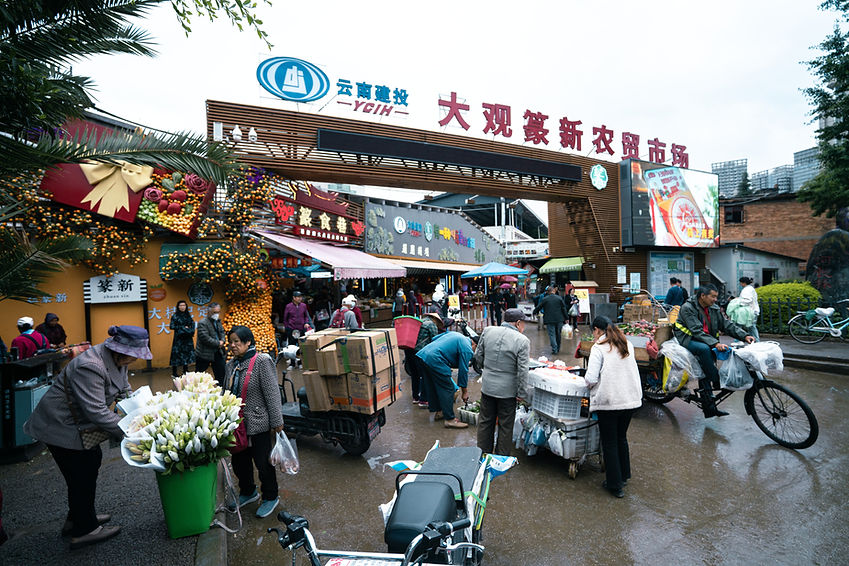
Vendor Days

Limestone Underworld

Getu River, Monsoon Season

River Village

Kunming, Yunnan (My Father's Hometown)

the Journey may take years

Why I won't take a photo of a Bhuddist Statue, even though I am not Bhuddist
One of photography's most important aspects, in my opinion, is the idea that every photo ever taken has layers of meaning hidden underneath its surface looks. Some photos certain have more than others. Some are like cereal box captions while others are like novels. I'll refer to these meanings as visual text. Learning to read and write visual text as a photographer is one of the hardest skills to master, but it is, I would argue, by far the most important. So let's take a look at three instances of different hypothetical photographs in an effort to unearth some common currents between their deeper visual texts.
For our first example let's imagine Annie Leibowitz takes a portrait of an African American model in a field of wheat at sunset. The surface visual text of that image is quite beautiful. The rolling yellow wheat is light up by golden hour against the backdrop of a burning sky. The golden tones surround and highlight the dark skin tones of the model in perfect exposure. But there are three levels of subtext to the image as well. Firstly, there is the photographer's. If Annie was the one framing the shot, why did she do it the way she did? Perhaps she wanted to portray a space where African Americans haven't traditionally felt comfortable now as confident and beautiful. Secondly, there is the subject's subtext. If the model wanted to be photographed at sunset, was it because of a sorry her grandfather told her when she was little, or a film photo she had of him in a field? Or even if the model had no say at all, how she felt alone in the field would certainly have an affect on her posture and facial expression, however slightly. We can deliberate on these two layers of subtext all day without conclusion, which would only come if we were able to speak to or read from the photographer or the subject themselves (a non human subject can also hold deep subtext independently of the photographer, more on this shortly). But it is the last layer of subtext which does not require any speaking or reading. The veiwer's subtext will be different for anyone, and it is what turns a photograph into a conversation. What do you feel, consciously or otherwise, when looking at that model in that field at sunset. Maybe it makes you emotional because of what happened to you in a field when you were in high school. Maybe it makes you want to go outside for a hike. Maybe it makes you confused about why photographers bring lights outside when the sun is still out. None are less valid than any others, each add value to the photograph.
Let me propose a second example to think about, so that we might apply the same layers of visual text. The surface text is large shining gold statue of the Buddha, in the center of an old wooden temple-looking building. So what is the photographer's subtext? We don't know, but we can guess based on the subject's. The subject is a sacred statue that is not allowed to be photographed. It has provided a path to spiritual enlightenment and a higher plane of existence for millions of people since long before America was on a map of the world. To photograph it would be to value your picture over the Buddhist culture and heritage.
Thousands walk right now to Lhasa, foreheads the size of small melons from bending down to the road at each and every step. They will visit the Buddha's statue there. The journey may take years. Tens of thousands sacrificed their lives in Tibet for the freedom to continue this spiritual practice. Knowing this, for me, the photo does not hold nearly as much value. So we might venture to guess that the photographer's subtext in this instance is that they are from a foreign country and are unfamiliar with the customs that are to be followed when visiting a Bhuddist temple. And finally, another example of how the viewer's subtext of this image would be very different if it was I who saw it, or a Bhuddist monk, or a middle schooler in New Jersey.
Now I want to make one thing clear. The reason not to take the photo has absolutely nothing to do with whether it is "allowed" or not. It is purely in relation to the weight of the visual text. Let me provide just one more example to better illustrate this point. You travel to Beijing, China's capital, and upon your search for a bathroom you enter a room in a building you were never supposed to. Peeking around a corner, you notice a group of government officials in a secret meeting, but they do not notice you so you prepare to snap a quick photo before leaving. One of the officials is being verbally abused by the others, and as you raise your camera to take the shot, he is physically hit. Better leave fast before they notice you. Now as it turns out, the official who was berated had posted something slightly off brand on social media that morning, and now you have the only photo of his punishment. Of course you were not allowed to take the photo, and there are a lot of people who would do anything in their power to have it deleted. But let's focused instead on the visual text of this photograph.
For you as the photographer, this level of corruption is a rare sight coming from another country. Surely that influences your subtext greatly. And for veiwer's from America the subtext will be very different than veiwer's from China looking at a photo of their own leaders. But the visual text from the subject is arguably the most powerful of the three, because even if your photo is never looked at by anyone else- if your card is confiscated or your film destroyed in the dark room- or if you are never able to explain your intentions, the subject of that photos still had their own feeling about it while it was being taken. It's the same reason I don't like to take photos of those who wish not to be photographed. My photograph is saying that I have a desire more important than their wish not to be captured. And sometimes the photo IS more important than that wish. But definitely not always. It's also the same reason taking a photo of some previously in photographed object GIVES that object some level of new import or meaning.
So I guess what I mean to say is that sometimes there are social or societal rules, or heritage or history, or even just one person's past experiences that inform the visual text of a photo you take in ways that you might not have expected. Breaking these rules, or going against cultural currents does not always outweigh the value of a potential photograph. Asking these questions before we take a photo, especially in areas or among people unfamiliar to us, I believe, makes us into better, more thoughtful photographers. And sometimes the thought will be that the photo is indeed more important. Than safety, or a belief system, or a habit. Because sometimes photos are symbols. And symbols, when wielded correctly, have the power to reverse what is wrong in the world.